I hate my Phone
October 1, 2026 | 1,932 words | 10min read
I hate my phone. And I don’t mean this in a polemical sense either. If I were asked to describe a device designed by the devil himself, I could not come up with a better device than a smartphone.

I hate the constant notifications. I hate how it is a constant source of distraction. I hate how owning a smartphone comes with the expectation of being available at all times. I hate how it has shifted many direct conversations we used to have into conversations mediated through text, or even worse, video calls. I hate how it normalized freeware and software riddled with ads. I hate how the idea of an open-source version of Android, available to everyone and modifiable by everyone, became a collection of locked-down, vendor-specific versions. I hate how much time I spend on it. I hate how much it has become necessary for everyday life, from two-factor authentication needed for everything to banking apps and navigation.
But if I had to pick one specific target for my dislike, it would be how it mediates and filters experience, so that the experience itself becomes secondary to what we can do with that experience.

The problem is not mediation itself. How we experience reality is always mediated through something, be it obvious examples such as glasses if we have problems with our sight, hearing aids if we have impaired hearing, or much more subtle things, such as the coffee we drink in the morning and the caffeine that so subtly changes our perception of reality. In fact, we can say that there is no such thing as an unmediated way of experiencing life. If you are familiar with some of my blog articles where I explore Heidegger’s thoughts or Buddhist dependent origination, this goes in the same direction.
“This is probably the case with all psychoactive drugs, but is especially true of caffeine, since the particular quality of consciousness it sponsors in the regular user feels not so much altered or distorted as normal and transparent. Indeed, for most of us, to be caffeinated to one degree or another has simply become baseline human consciousness. Something like 90 percent of humans ingest caffeine regularly, making it the most widely used psychoactive drug in the world, and the only one we routinely give to children (commonly in the form of soda). Few of us even think of it as a drug, much less our daily use of it as an addiction. It’s so pervasive that it’s easy to overlook the fact that to be caffeinated is not baseline consciousness but, in fact, an altered state. It just happens to be a state that virtually all of us share, rendering it invisible.”
~ Michael Pollen, This is your mind on Plants
The problem is how smartphones mediate experience. Before I can talk about this, I want to first talk a bit about time.
If we look at time, there is something strange about how we perceive it. The past is over and can never be regained, and the future is not here. We can do all the wishing we want, but the future will not come sooner. The Stoic Seneca already echoes this:
Life is divided into three periods—that which has been, that which is, and that which will be. Of these the present time is short, the future is doubtful, the past is certain. […] The past is the one over which Fortune has lost control, the one which cannot be brought back under any man’s power. […] Present time is very brief […] for it is always in motion, it ever flows and hurries on; it ceases to be before it has come.
~ Seneca, On the Shortness of Life, X
For a more Christian perspective, Saint Augustine talks about something very similar:
(23) Wherever they are, whatever they are, they do not exist except in the present. When a true narrative of the past is related, the memory produces not the actual events which have passed away but words conceived from images of them … Thus my boyhood, which is no longer, lies in past time which is no longer. But when I am recollecting and telling my story, I am looking on its image in present time, since it is still in my memory … we frequently think out in advance our future actions, and that premeditation is in the present; but the action which we premeditate is not yet in being because it lies in the future.
(26) What is by now evident and clear is that neither future nor past exists…
~ St. Augustine, Confessions, XI.18.23, 26

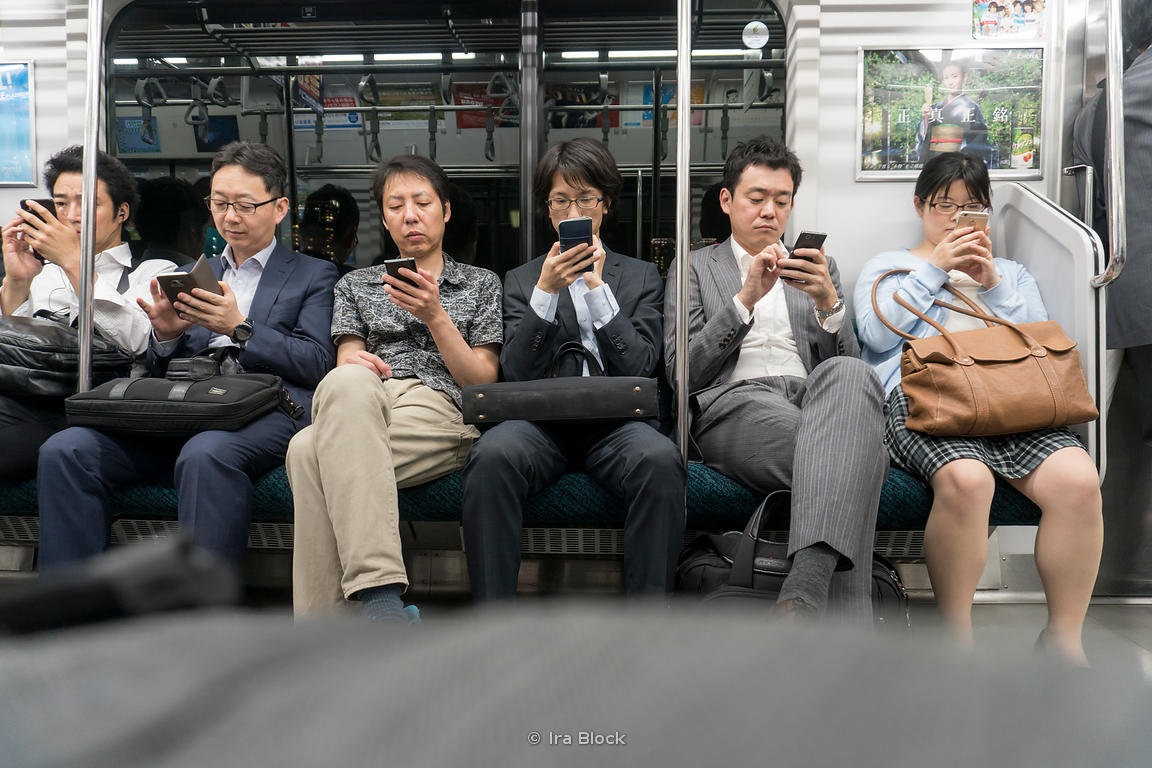
Hence, there is something very insidious about how smartphones work. Who does not know the experience of being on a family holiday when suddenly something beautiful catches your attention, perhaps a building, a landscape, or some food, and immediately the smartphone is taken out and photos are made?
This introduces a new layer to how we experience reality. Before, the experience might simply have been: world → experience. Now every moment can become: world → experience → “I should photograph this” → photograph → edit → share → reactions.
And what is important here is not the act of taking the photo itself, but that the possibility of doing so is always somewhere in the back of your mind. It changes our thought patterns and how we experience the world.
An experience cannot simply be experienced for its own sake wholeheartedly, where one just marvels at the experience itself. The possibility of taking a photo introduces thoughts such as: How does this look through the camera? How is the lighting? Are those people in the way? And so on.
We become distracted from wholeheartedly embracing an activity and instead run on a hamster wheel of thoughts, even when those thoughts are not obvious or fully conscious, but instead operate in the background.
Let’s think about why people take photos. The most common response is probably something like: I want to preserve this beautiful moment so I can look at it later. But this is problematic on multiple levels.
- As already described, only the present truly exists. We are trading the nonexistent future for the existing present. When we are not wholeheartedly present and instead think about future plans, we are not really living in the present.
- This mentality of preservation contains the idea of capturing a moment and somehow eternalizing it. But this is fundamentally at odds with the fact that everything is constantly changing. Reality never remains fixed. By these little acts of preservation, we reinforce the illusion that things can remain unchanged. This can lead to nostalgia for the past, even though the past no longer exists.
- it also undermines the future present. When that future moment finally arrives, instead of focusing on the present, we may find ourselves focused on the past and trying to recreate or remember something that has already passed.
So, to summarize: in the existing present, we instead focus on the nonexistent future, and in the future present, we focus on the nonexistent past. This is madness.
One Buddhist monk describes this very well:
If while washing dishes, we think only of the cup of tea that awaits us, thus hurrying to get the dishes out of the way as if they were a nuisance, then we are not “washing the dishes to wash the dishes.” What’s more, we are not alive during the time we are washing the dishes. In fact we are completely incapable of realizing the miracle of life while standing at the sink. If we can’t wash the dishes, the chances are we won’t be able to drink our tea either. While drinking the cup of tea, we will only be thinking of other things, barely aware of the cup in our hands. Thus we are sucked away into the future —and we are incapable of actually living one minute of life.
~ Thích Nhất Hạnh, The Miracle of Mindfulness: An Introduction to the Practice of Meditation
A Minimal Smartphone
Still, all this being said, I am still reliant on my smartphone on a day-to-day basis. The most essential things are all kinds of two-factor authentication, navigation of public transport, and, lastly, messaging with family. So sadly, I cannot yet get rid of my phone. One can dream.
But I can do the next best thing, which is minimizing my phone to its essentials. That is what I want to outline in the next few steps. First, keep in mind that what I suggest below only works for Android and may damage your phone.
The first thing I suggest is installing Olauncher, which is a minimal interface for your Android phone. It removes all those pesky app icons littered across your home screen and replaces them with a simple list that you can scroll through to find the app you want to start.
Why do this? We want to minimize our phone to the basics we really need. The colorful icons and all the fancy stuff are unnecessary bloat that distracts from what your phone is really for: a tool meant to be used, not one that uses you.
The first thing we want to do is enable ADB. This basically lets us change things on our phone using our computer. To do this, you first need to enable developer settings. If you have not done so already, you can usually do this by tapping the build number around seven times in your settings. After that, you can go into the developer settings and enable ADB.
Now that we have enabled ADB, we can connect it to our phone. With adb devices, you should be able to see your phone. I would then suggest making some backups in case something goes wrong. To back up your SD card, you can use ADB:
❯ adb pull /sdcard/ ~/phone-backup/
Also back up Google and WhatsApp, if you use them, as well as any other apps that are important to you and offer cloud backups.
There are two main sources of distraction that we want to remove. The first is bloatware installed by the OEM, basically the manufacturer of the phone. The second is apps that we manually installed ourselves.
Let’s start with the first. For this, I suggest using Universal Android Debloater Next Generation. After you have installed it, open it. If your smartphone has ADB enabled and is connected to your computer via a cable, you should now see a bunch of apps that can be removed.
I would suggest using the recommended list. Select the apps from that list and remove them. Then check whether your phone is still working properly. If something goes wrong, you can either reinstall the apps using the program or factory-reset your phone, which should also automatically reinstall the removed programs.
For manually installed apps, you can use the following command in the terminal:
1❯ adb shell pm list packages -3 | sed 's/^package://' > ~/phone-backup/user-apps.txt
This generates a list of all the apps installed on your smartphone. Edit the list and remove all the apps you want to keep. If you are unsure what a particular app is because of its cryptic package name, use Google to search for it.
After that, if you use Fish as your shell, you can use the following command to remove the apps remaining on your list:
1 while read -l package
2      if test -n "$package"
3          echo "Removing $package"
4          adb shell pm uninstall --user 0 "$package" </dev/null
5      end
6  end < ~/phone-backup/user-apps.txt
 reply via email