My 10-Day Vipassana Retreat at Dhamma Sampatti (Black Forest)
March 18, 2026 | 3,944 words | 19min read
This article is meant to be a report of the 10-day Goenka meditation course. It does not cover any meditation techniques or the theory behind them.
Before registering for a course like this, understand what this course is and what it isn’t. This is a 10-day course where you will be meditating every day for 5–10 hours, and you will not do much else besides taking care of your physical needs. You will also not be talking to anyone else.
If you think you cannot occupy yourself only with yourself for hours upon hours, be it because of past traumas or difficult states of mind you find yourself in, this course is not for you. If you have any mental illness, such as depression, schizophrenia, bipolar disorder, and so on, this course is not for you, talk with your therapist.
The people at the meditation center are trained in the meditation technique, not as professional mental health practitioners. If you have some sort of episode, they will not be able to properly help you, they will give you suggestions based on their meditation framework. Know yourself best.
Otherwise, things like this can happen.
Also, this is a meditation retreat, not a therapy session. If you think participating in one of these retreats will solve all your mental problems, you are mistaken, again talk with your therapist.
Neither is this an adventure holiday where you go just because you want to challenge yourself.
The purpose of the course is one thing and one thing only: learning the Vipassana meditation technique as taught by Goenka and becoming better at it.
0. Background: How did I come to meditation
Skip this section if you are not interested in how I came to meditation and then to this 10-day course.
The first time I became aware (no pun intended) of meditation was probably when I was a child. During a car drive with my family, one of my siblings meditated. This was completely confusing to me, wait you just sit around and do nothing? When you could instead read something or play on the Nintendo? That must be boring. But alongside this rejection, there was also curiosity on my part: why would anyone do this? How could someone sit still for so long (relatively speaking, for a child)?
After this, I occasionally thought about it but never seriously looked into it. My next contact with it was in my early teenage years, by complete accident. There were no fantasy books at home anymore for me to read, and the next trip to the library was days away, so I picked up a copy of Sophie’s World from my parents’ bookshelf.
This introduced me to philosophy, and I began buying and reading philosophical works. I still remember exactly which ones: Plato’s Symposium, Sam Harris’ Free Will, Plato’s Republic, and Kierkegaard’s Either/Or. I only read the first three, and only really understood the first two. After that, I stopped, philosophy seemed too complicated, and my interest moved on.
However, I began listening to Sam Harris, and anyone who has listened to him knows how much he loves talking about meditation. This renewed my interest, and I bought the book The Mind Illuminated: A Complete Meditation Guide Integrating Buddhist Wisdom and Brain Science for Greater Mindfulness. I started meditating with it, but never seriously, and because I didn’t see any real improvement in my ability to focus on the breath, I eventually gave up.
My third wave of interest in meditation started about a year ago. I took a philosophy course at university, and my interest was renewed. I began reading again, and one pivotal book was Sam Harris’ Waking Up: A Guide to Spirituality Without Religion. In it, he described long meditation retreats, up to three months, and how he learned to enter states of bliss at will. This sounded almost fantastical to me.
But then I thought: you only live once. At least once in my life, I want to do a longer retreat; simply to know what it is like, and maybe finally find out whether meditation is really something worthwhile that I can progress in.
So I started looking for Vipassana retreats in Germany, and one of the first things that came up was dhamma.org, which offers courses in the style of Goenka around the world. As luck would have it, there was a center near me, only about three hours away, newly opened. Additionally, everything was donation-based, which made me, as a student with limited resources, very happy.
So I made the plan that after finishing my bachelor’s degree and switching to my master’s in computer science, I would have more time and could do this retreat. And that is how I came to this course.
At this point, it might be useful to list my goals for this meditation retreat:
- Simply for the experience: I wanted to do a longer retreat once in my life, to know what it is like
- I wanted to know if I could make progress in meditation
- I wanted to see if I could reach interesting states of mind, like those described by Sam Harris or Robert Wright in Why Buddhism Is True
- I wanted to know whether one can have direct access to consciousness (see Philip Goff on transparent vs. opaque, Bernardo Kastrup on analytical idealism, and Schopenhauer’s The World as Will and Representation)
1. Registration
If you have decided to take part in one of these courses, you can register via this link, which shows all the different courses offered throughout the year.
They offer different types of courses, but for new students, those who have never attended a Vipassana course in the Goenka tradition, only the 10-day courses are relevant. These courses are structured in such a way that they teach you the entire technique, with each day building upon the previous one.
Only after successfully completing a 10-day course will you be considered an “old student,” meaning you have properly learned the technique. Only then can you participate in shorter courses (like 3-day courses), longer courses, or serve as a volunteer. The same applies to being a service helper, you must first complete a 10-day course.
Now, let’s say you find a course that fits your schedule. It is important to know that these courses are very popular and fill up quickly. If you want a place, be there at the exact time registration opens. Registration may only remain open for an hour or two before everything is full.
They may reopen registration in the following days, but you will most likely end up on the waiting list, meaning you depend on others canceling. Registration typically opens 1–3 months before the course begins.
In my case, I missed the initial registration and only signed up the next morning, which put me on the waiting list. Only two weeks before the course started did I receive confirmation that I was accepted.
So if you need to plan ahead, make sure to register on time.
Besides the Dhamma Sampatti center where I registered, there are centers all around the world, so if you don’t get into one, you can try another. Officially, I think you are not supposed to register for multiple courses at once, but I met someone who applied to around ten courses across Europe at the same time because they needed a specific date and it worked out for them. They didn’t receive any reprimand, but I still wouldn’t recommend doing this.
2. Arriving at the Center
The center (Dhamma Sampatti) is near the village of Seebachwald in the Black Forest. It is located in the former Hotel Hohritt, which was acquired by the Vipassana organization and modified into a meditation center. The history of the building is quite interesting, if at the end of the course, they offer a tour, I highly recommend participating.
The hotel was originally built in the 1930s and was used by German soldiers. Later, it burned down in what became the largest Fachwerkhaus fire in Germany. It was then rebuilt and eventually sold to the Vipassana organization.
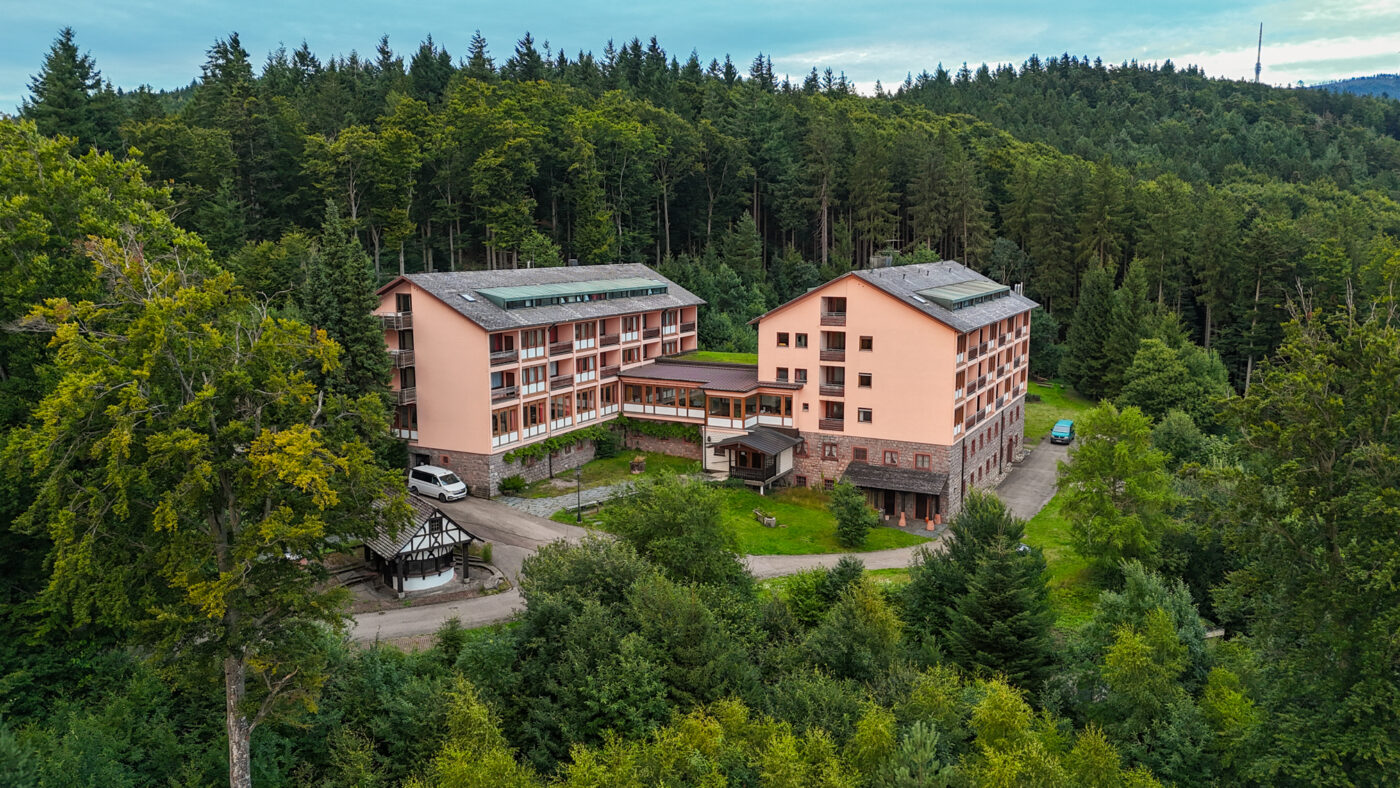
How do you get to the center, Dhamma Sampatti? The easiest way is by car. Germany has (mostly) excellent roads, and there is a road that goes directly up to the center.
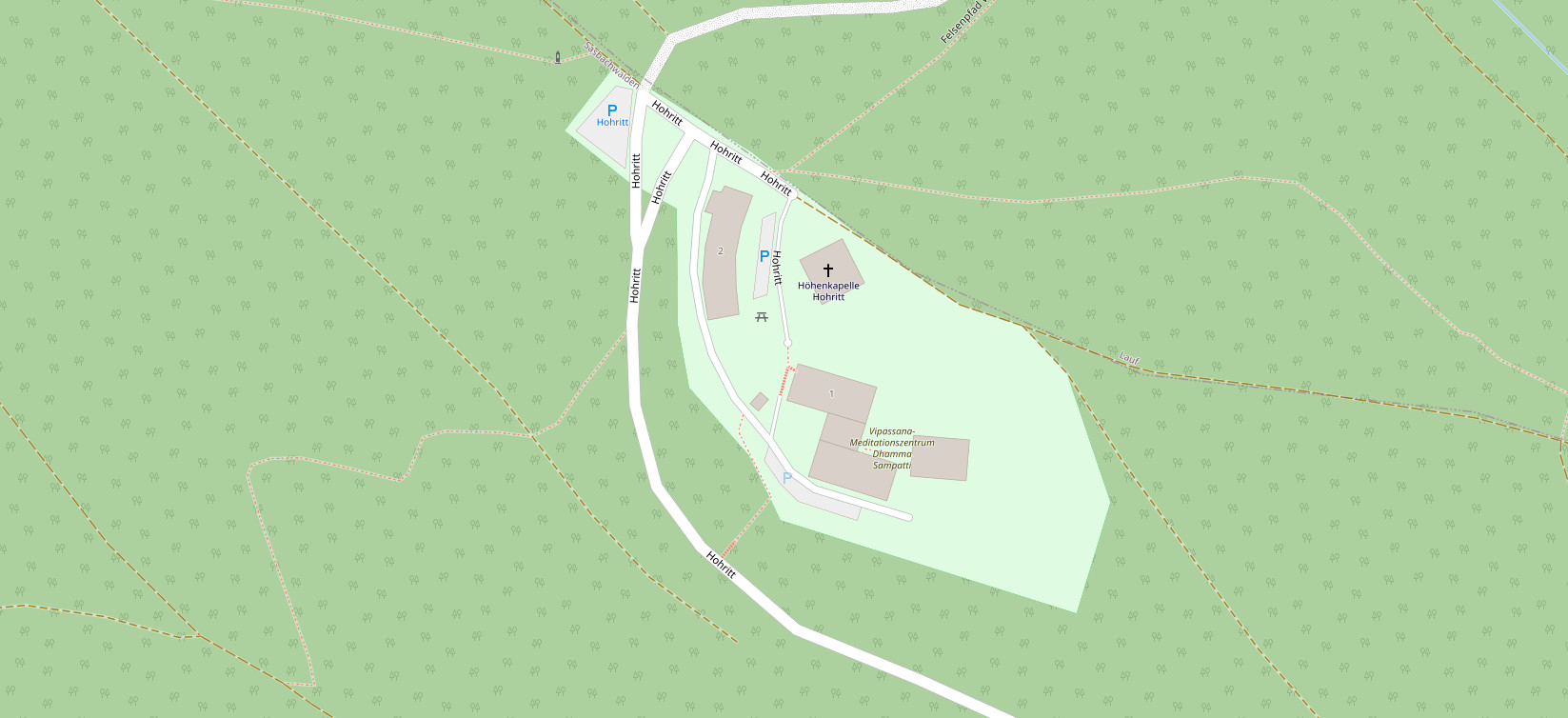
If you do not have the luxury of owning a car or don’t want to use a taxi (which can get expensive quickly), public transportation is an excellent option. It depends on where you are coming from, but typically you would first go to Karlsruhe, then take a regional train to Achern. From the station, you can take either bus 400 or bus 423. The 423 runs somewhat irregularly, while the 400 is more reliable and takes about 20 minutes. You can get off at the stop “Seebachwald, von Hohritt.”
From there, you will need to walk up a hill through the forest, which takes around 15 minutes. At the top, there are three buildings: a church, a long house, and a large house. The large house is where you want to go, and there should also be signs pointing the way.
3. The 0th Day
After you arrive in the main hall, people are separated based on gender. Men register in the male dining hall, while women register in the female dining hall.
In the dining hall, you will need to read and fill out a form. This form outlines a number of rules (e.g., the Five Precepts, not attending with serious mental illness, etc.) and asks questions about things like drug use, prior meditation experience, and your general mental state.
Some of these questions might feel quite intrusive, and you will need to officially sign the form, agreeing to things like staying for the full ten days. It can feel a bit like a sect at first.
As far as I can tell, the form serves several purposes:
- It emphasizes seriousness. Like the warning at the beginning of this article, they want to make sure you understand what you are getting into, that this is something intense and not just a casual activity.
- The act of signing reinforces Adhiṭṭhāna (strong determination). It is a commitment to yourself: “No matter what happens, I will stay for the full 10 days.”
- The rules themselves exist to support the practice. Overall they seem sensible and helpful for Vipassana meditation, they are partly explaiend in the evening discoursed durign the retreat.
- It helps filter participants. People who are mentally very unstable, recently experienced severe trauma, or have substance abuse issues may be excluded. This is because Vipassana should be practiced with a relatively stable and tranquil mind.
- It provides context for the teacher. During the course, you will have time to ask questions about the technique. The form can help the teacher understand your background. For example, before attending the retreat, I practiced using The Mind Illuminated, which involves counting breaths. Since this is not done in Goenka-style meditation, I had difficulty letting go of that habit, something that was useful for the teacher to know.
After you have signed the form and handed it in, they will ask you to turn off your phone and give it to them. All phones are stored in one place and returned at the end of the retreat. So make sure to finish anything important beforehand and inform family or loved ones that you will not be reachable.
They will also ask you to hand in anything that could entertain you, such as books or other distractions. Like your phone, you will get these back at the end of the course.
It is important to note that they will not search your bags. This rule is based on trust. If you secretly keep something like a book and are seen using it, they will likely talk to you about it and might even ask you to leave. Technically, nothing prevents you from sneaking something in, but that would miss the point of the retreat.
If you feel the urge to bring something like a book because you are afraid of being bored, you should ask yourself whether this is really the right course for you. The purpose is to give the technique a fair chance, which requires complete focus. If you want a less intensive experience, there are many alternatives, but if you choose a Goenka-style retreat, you are choosing intensity, and that includes accepting the rules.
Afterward, they will give you a key to your room, and you are free until dinner. You can use this time to explore the grounds and, if you have a roommate, discuss practical matters like heating, ventilation, and alarm times.
After dinner, you will have your first meditation session, which lasts about an hour. Then it is already time to go to bed.
From the next day onward, “noble silence” begins, meaning you should not talk to other participants. However, if you need anything practical, you can speak to the course manager, and if you have questions about the technique, you can ask the teacher during designated Q&A times.
4. Schedule of the Rest of the Days
The rest of your time at the retreat follows a strict schedule. This schedule only changes slightly on the 4th day (when a new meditation technique is introduced) and on the 10th day, when noble silence is lifted and students can share their experiences.
Daily schedule:
- 4:00 am — Morning wake-up bell
- 4:30–6:30 am — Meditate in the hall or in your room
- 6:30–8:00 am — Breakfast break
- 8:00–9:00 am — Group meditation in the hall
- 9:00–11:00 am — Meditate in the hall or in your room according to the teacher’s instructions
- 11:00–12:00 pm — Lunch break
- 12:00–1:00 pm — Rest (and interviews with the teacher)
- 1:00–2:30 pm — Meditate in the hall or in your room
- 2:30–3:30 pm — Group meditation in the hall
- 3:30–5:00 pm — Meditate in the hall or in your room according to the teacher’s instructions
- 5:00–6:00 pm — Tea break
- 6:00–7:00 pm — Group meditation in the hall
- 7:00–8:15 pm — Teacher’s discourse in the hall
- 8:15–9:00 pm — Group meditation in the hall
- 9:00–9:30 pm — Question time in the hall
- 9:30 pm — Retire to your room (lights out)
At 4:00 am and again at 4:30 am, a staff member walks through the dormitory ringing a bell to wake everyone up. This gives you time between 4:00 and 4:30 for your morning routine, like brushing your teeth. From 4:30 to 6:30, you can either meditate in the hall with others or in your room.
A few important notes: nobody checks whether you wake up on time. These sessions are not “mandatory” in a strict enforcement sense, but it is expected that you follow the schedule. Personally, I often went back to sleep and only attended a few of these early sessions.
That said, I would recommend participating at least occasionally. First, if you wake up early enough, you will meditate through the transition from night to day, which feels very special, a monastic experience. Second, only during these morning sessions is your meditation accompanied by chanting. While that might not sound appealing at first, after many days of repetition, even small variations like this can be refreshing.
From 6:30 to 8:00 is breakfast. Depending on the center, actual eating time may be shorter (for me it was about 45 minutes), as the remaining time is used by staff to clean and prepare for the next session. Fasting during the retreat is not recommended.
From 8:00 to 9:00 is the first mandatory group session. Attendance is expected, and if you are missing, they may come looking for you. From 9:00 to 11:00, you can again meditate either in the hall or in your room.
In general, there are three types of meditation sessions:
- Mandatory group sessions — You are expected to be in the hall.
- Flexible sessions (“hall or room”) — You can choose where to meditate.
- Teacher-directed sessions — The teacher may ask specific groups (e.g., men or women) to stay for guidance or questions.
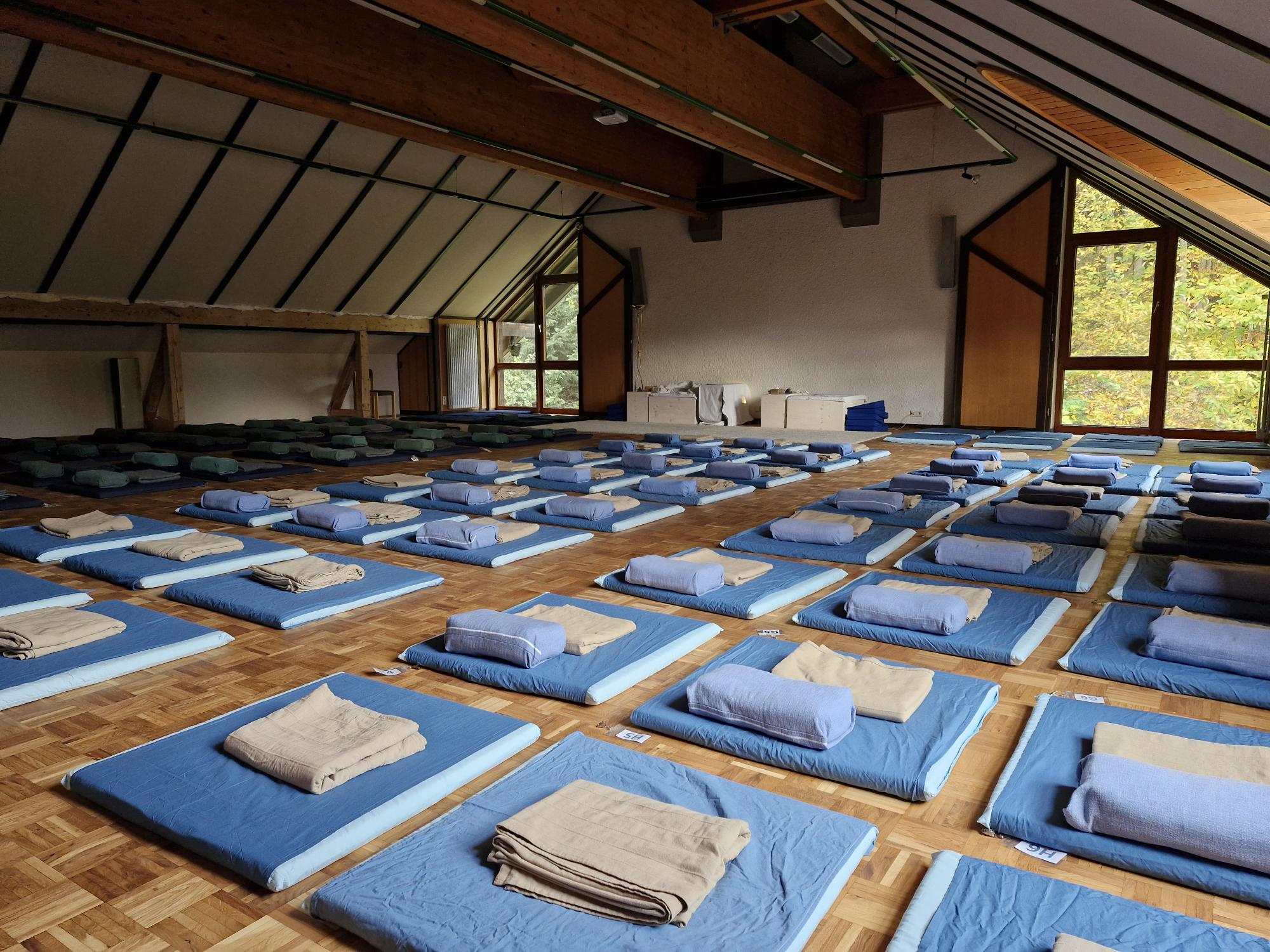
Meditating in the hall provides structure and accountability, the group atmosphere helps focus. Meditating in your room gives you more freedom, for example to lie down briefly if needed. I recommend trying both; personally, I preferred the group sessions.
There is also a difference in strictness. During mandatory sessions, you are expected to remain seated for the full hour. In non-mandatory sessions, you can take breaks, leave the hall walk around briefly, and return. Both have advantages: mandatory sessions are quieter and more stable, while flexible sessions help you build equanimity toward distractions.
You might notice that there is no “dinner,” only a “tea break.” This is because there are essentially only two full meals per day. New students may eat some fruit during the tea break, while old students (those who have already completed a course) typically only drink tea. I’m not entirely sure of the reasoning behind this, but that is how it is structured.
In the evening, there is a discourse. These are recordings of Goenka (who has since passed away) and are available in different languages. They explain both the technique and the theory behind it.
Personally, I found many of these talks quite sensible, especially Goenka’s pragmatic approach: he emphasizes not blindly believing anything, but instead verifying everything through your own experience. He also explicitly says that you do not need to accept parts that seem too mystical. If you critically evaluate the discourses and take what is useful, they can be quite helpful in understanding the practice.
5. Miscellaneous
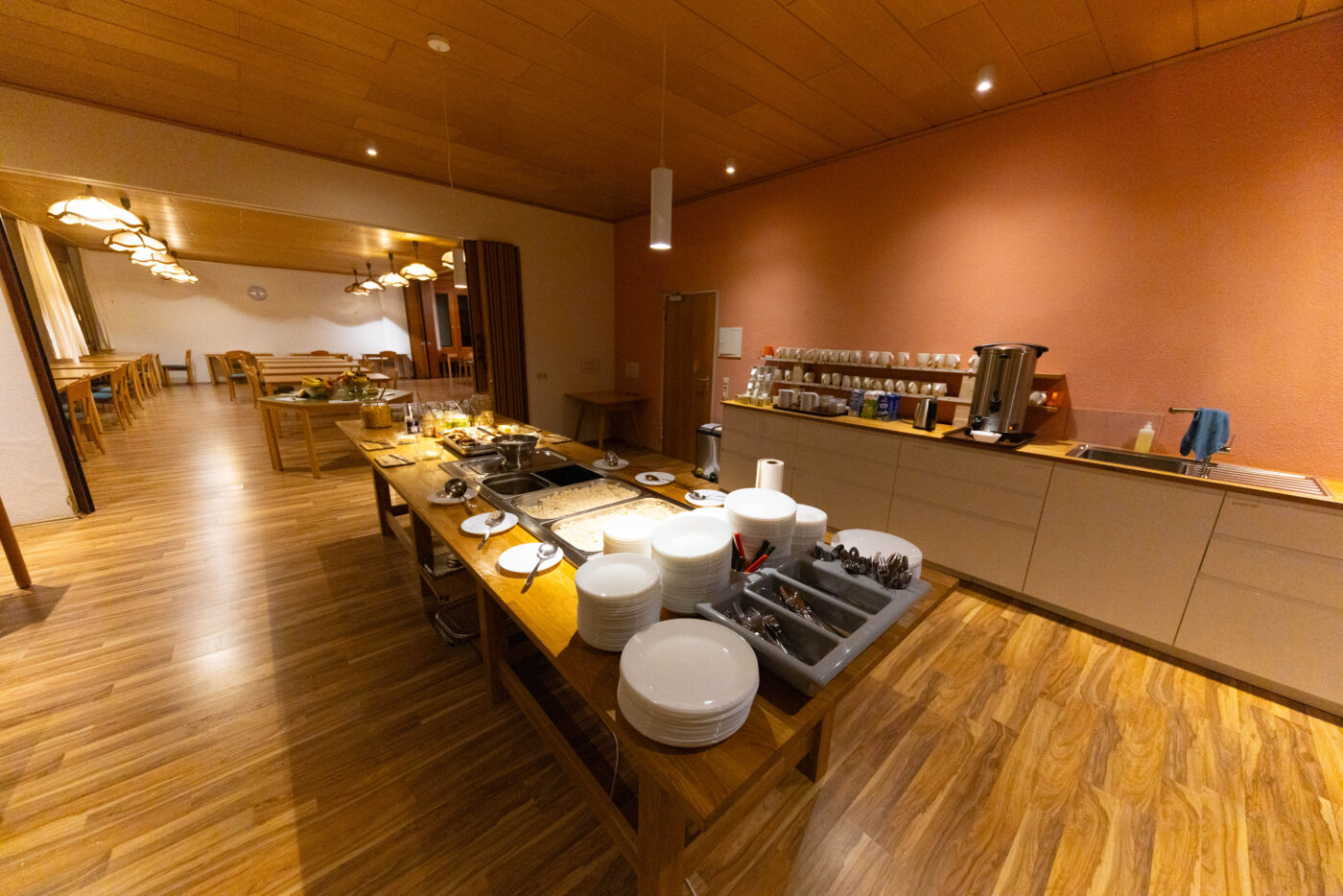
Food: The food is simple and vegetarian. If you have allergies, they try to accommodate you as best as possible. During lunch, there is usually a salad bar with different dressings and various toppings like nuts, which is a nice touch. Overall, the food is decent, not amazing, but not bad either. That said, they had the best marinated tofu I’ve ever eaten.
Hygiene and laundry: Showering and washing clothes should be done during break times (early morning, breakfast, lunch, or tea break). Laundry must be done by hand, so it’s best to bring enough clothes to avoid frequent washing.
Free time: When you are not meditating, eating, listening to lectures, or taking care of hygiene, you can walk around the property. There is forest right next to the center with some nice walking paths. However, you are not allowed to leave the property.
6. Experience
For me personally, the hardest thing was the food. Normally at home I eat lunch and dinner and skip breakfast, but here it’s the opposite: eating breakfast and lunch while skipping dinner. The first few days, my stomach really didn’t like it. I had to force the food down, particularly during breakfast. But after a few days, this stabilized.
The same was true for the sleeping rhythm. I am used to waking up at around 8 am and going to bed at midnight, whereas here it was waking up at 4 or 6 am. This also took some time to get used to.
Now to the actual meditation. I rarely felt bored, because what is boredom? It comes from being unoccupied and lacking interest in doing anything. But meditation is not doing nothing. It is doing something: observing either the breath or the body. So during meditation, I didn’t really get bored, especially during body scans. And since you are meditating most of the time or following a strict schedule, there is almost always something to do.
What also helped is that you are not doing the exact same technique every day. Like a regular boot camp, the techniques evolve over time. With each day, you progress, and the practice develops further, which made me curious about what would come next.
As for the experience of meditation itself, I never had any mystical experiences or feelings of bliss, ecstasy, or strong elation. Some meditation sessions felt frustrating, but in most I just felt relaxed. The biggest difference I noticed in my state of mind was after meditation sessions: my mind felt empty. The constant stream of thoughts was reduced, and I felt more present.
One small, somewhat funny moment: after one session, when we went outside for a break, the sun was shining on a particular field. About ten of us just stood there in a row, facing the sun, silently enjoying it. It was a strangely memorable image.
I also felt that the long sessions really helped with making progress. One reason I think I didn’t improve much when practicing with The Mind Illuminated was that I only did short daily sessions (around 20 minutes). Doing much longer sessions here seemed to accelerate progress.
One negative experience I had was near the end of the retreat. During the last two days, after longer meditation sessions, I developed something like a headache. It felt quite uncomfortable, and in retrospect, I think I was trying too hard—over-concentrating.
From what I’ve said so far, it might sound like my experience was mostly just relaxation, and not much more. But I am probably not the norm. When I talked to other people, they described much more transformative experiences, working through past memories or even traumas.
For example, one person told me that during body scans, different emotions and memories were associated with different parts of the body. Scanning the chest brought up past relationships, scanning the legs brought up memories related to sports, and so on.
I experienced none of this. No particular emotions or memories came up, and no past issues resurfaced. I think I might be more of an exception here, and there could be several reasons:
- My life has been relatively uneventful in that sense of having no major traumas or particularly negative experiences.
- I am generally not a very emotional person and don’t tend to ruminate much on past memories.
- There may also be a kind of expectation effect: I approached meditation in a more “scientific” mindset, focused on training attention and building habits, and didn’t expect anything deep or emotional to arise.
7. Final Thoughts
You get out of this retreat what you put into it. You can choose to goof off and relax the whole time, but that will likely become boring. Or you can take the schedule seriously and fully engage with the experience.
In the end, it helps to think of this like any other kind of intensive training or bootcamp. For example, at a running camp, you run a lot to improve quickly. At a chess retreat, you play chess all day. Here, you meditate.
Nobody is forcing you to be there, you chose it. And the time you get there, free from distractions and separated from the outside world, is extremely valuable. You can use it as focused training.
Meditation, in this sense, is just a skill like any other. There is no need to make it overly mystical or to accept any religious framework if you don’t want to.
To summarize, I think that if one is mentally healthy enough, this is a worthwhile endeavor. Don’t expect anything mystical or transformative to happen, but also don’t rule out the possibility entirely. The center where I stayed was nice: good food, a beautiful landscape and view, a calm atmosphere, and friendly people. The technique itself was not overly religious and was well explained. I especially liked Goenka’s pragmatic “see for yourself” approach.
I would do it again.
 reply via email