A Step Towards Personalized Sports Nutrition: Carbohydrate Intake During Exercise
July 22, 2026 | 685 words | 4min read
Paper Title: A Step Towards Personalized Sports Nutrition: Carbohydrate Intake During Exercise
Link to Paper: https://pubmed.ncbi.nlm.nih.gov/24791914/
Date: 2014 (Sports Medicine)
Paper Type: Sports Nutrition, Carbohydrate Metabolism, Endurance Exercise, Personalized Nutrition
Short Abstract: This review consolidates a decade of breakthroughs in carbohydrate (CHO) metabolism research, oral carbohydrate sensing, multiple-transporter intestinal absorption, gut training, and dose–response data, to replace the generic ACSM guideline of 30–60 g/h with tiered, event-specific recommendations. Jeukendrup argues that CHO advice should depend primarily on exercise duration (30 min to >2.5 h), with additional consideration of absolute intensity, carbohydrate type, and individual gut adaptability. The framework distinguishes three regimes: short-duration exercise where oral CHO receptors alone can improve performance; prolonged exercise where single-source CHO oxidation maxes out at ~60 g/h; and ultra-endurance where multiple transportable carbohydrates (glucose:fructose) raise oxidation to ~90 g/h. Body-weight-normalised advice is explicitly rejected as unsupported by the data.
Key Findings
The Mouth Rinse Effect and Short-Duration Exercise
For exercise lasting roughly 30–75 minutes at ~75% VO₂max, performance benefits from CHO are neural, not metabolic. Infusing glucose directly into the bloodstream fails to improve performance, yet rinsing the mouth with a CHO solution (without swallowing) produces similar gains to full ingestion. Oral carbohydrate receptors, distinct from sweet-taste receptors, activate brain regions including the orbitofrontal cortex and anterior cingulate cortex, modulating motor output. The recommendation for this duration is modest: ~30 g/h of any carbohydrate type, and a mouth rinse may be sufficient.
Prolonged Exercise and the Single-Transporter Limit
For exercise lasting 2–3 hours, CHO becomes a critical fuel. Exogenous carbohydrate oxidation maxes out at ~60 g/h due to saturation of the intestinal sodium-dependent glucose transporter (SGLT1). This forms the basis for the recommendation of ~60 g/h using a single CHO source (glucose, maltodextrin, sucrose).
Ultra-Endurance and Multiple Transportable Carbohydrates
The key breakthrough (Jentjens et al., 2004): co-ingesting a second carbohydrate using a different intestinal transporter (fructose via GLUT5) raises oxidation rates to ~90 g/h, a 50–75% increase. Glucose:fructose and maltodextrin:fructose mixtures in roughly 2:1 ratios achieve the highest rates. Performance benefits appear in exercise lasting ≥2.5 h: ~8% additional power output over glucose alone (Currell & Jeukendrup, 2008), reduced perceived exertion, better sprint performance, and faster race times (Rowlands et al., 2012). The mechanism is intestinal, multiple transportable carbohydrates reduce unabsorbed CHO accumulation in the gut, lowering gastrointestinal distress while delivering more fuel.
Dose–Response Evidence
Well-controlled studies (Smith et al., 2010, 2013) confirm a genuine dose–response relationship between CHO ingestion rate and performance. Across 51 cyclists ingesting 10–120 g/h of glucose:fructose (2:1), performance improved dose-dependently with maximal effects at 60–80 g/h, consistent with meta-analytic results (Vandenbogaerde & Hopkins, 2010).
What Does Not Matter: Training Status and Body Weight
Training status does not affect exogenous CHO oxidation rates when matched for relative intensity, trained and untrained subjects show identical rates (Jeukendrup et al., 1997; van Loon et al., 1999). Body weight shows no correlation with exogenous CHO oxidation, because intestinal absorption capacity, not muscle mass, is the limiting factor. Jeukendrup explicitly argues against expressing recommendations per kg of body weight, favouring absolute grams per hour.
Training the Gut
The intestine is adaptable: a high-CHO diet (6.5 g/kg/day) combined with CHO supplementation during training for 28 days upregulates intestinal transporters and increases exogenous CHO oxidation (Cox et al., 2010). Athletes are advised to practise their competition nutrition strategy in training to reduce gastrointestinal discomfort and enhance absorptive capacity.
Real-World and Sport-Specific Considerations
Field studies show wide variation in actual CHO intake across sports: highest in cycling and triathlon, lowest in marathons. Ironman data shows a positive correlation between intake and finish time. CHO oxidation rates are similar in cycling and running, so advice does not differ between the two. For intermittent team sports (soccer), CHO ingestion improves not only endurance but also skill components, agility, dribbling, shooting accuracy, especially late in a game, though mechanisms remain unknown.
Practical Recommendations
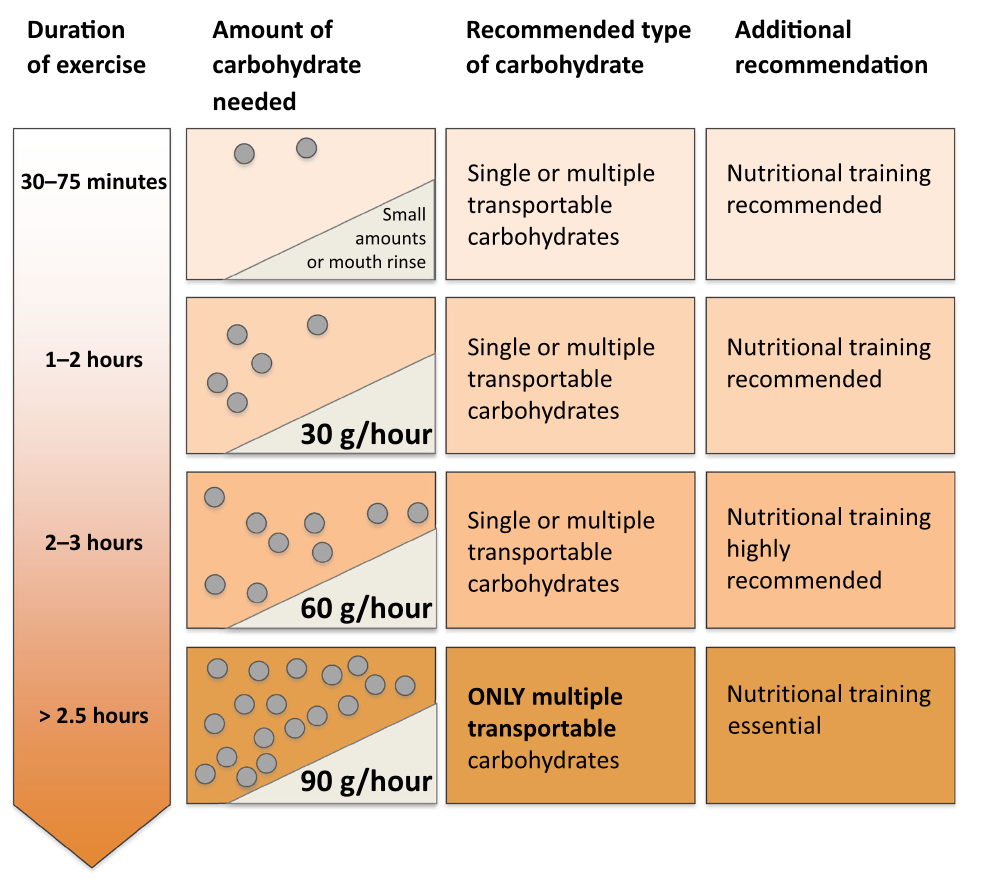
Carbohydrate can come from drinks, gels, or low-fat/low-protein bars selected by personal preference. Intake must be balanced with fluid planning. Athletes at lower absolute intensities should adjust amounts downward, as total CHO oxidation at low intensities may be exceeded by high intake rates.
 reply via email