Mindfulness, Cognition, and Long-Term Meditators: Toward a Science of Advanced Meditation
July 24, 2026 | 984 words | 5min read
Paper Title: Mindfulness, Cognition, and Long-Term Meditators: Toward a Science of Advanced Meditation
Link to Paper: https://pubmed.ncbi.nlm.nih.gov/40800948/
Authors: Ehmann S., Sezer I., Treves I.N., Gabrieli J.D.E., Sacchet M.D.
Date: 2025 (Imaging Neuroscience, Volume 3)
Paper Type: Review, Mindfulness Meditation, Cognitive Neuroscience, Neurophenomenology
Short Abstract: This review synthesizes behavioral and neurocognitive evidence from studies of long-term meditators, defined as individuals with at least 1,500 hours of practice. Across perception, emotional processing, decision-making, and non-ordinary states of consciousness, long-term meditators show enhanced sensory clarity and reduced affective reactivity, supported by a neural shift from top-down cognitive control toward bottom-up, salience-driven processing. The authors distinguish long-term practitioners from true advanced meditators who possess skill-based mastery of deep states such as absorptive concentration and non-dual awareness. Significant methodological limitations are identified, and a unified neurophenomenological framework for studying meditative development is proposed.
Introduction
Mindfulness meditation originates in Buddhist traditions, particularly the Satipatthana, which emphasizes two interrelated faculties: sati (mindfulness) and sampajañña (clear comprehension). In secular contexts, Kabat-Zinn defined mindfulness as paying attention to the present moment intentionally and without judgment, forming the basis of Mindfulness-Based Stress Reduction and related interventions with demonstrated efficacy for depression, anxiety, chronic pain, and addiction.
This review adopts Young’s (2016) three-dimensional model of mindfulness skill:
- Concentration: the ability to sustain attention on a chosen object
- Sensory Clarity: the capacity to discern fine details of sensory experience
- Equanimity: maintaining non-reactivity as experiences arise and pass
A critical conceptual distinction is drawn. A long-term meditator (LTM) is defined by accumulated practice hours (here, at least 1,500). An advanced meditator (AM) is defined by actual skill mastery, including access to states like jhana (absorptive concentration) and non-dual awareness. The authors argue that studying AMs is essential for understanding the deeper transformations meditation can produce, but few existing studies collect the phenomenological data needed to make this distinction.
Methods
This is a review of existing studies, not a new empirical investigation. Studies were included if participants had at least 1,500 hours of meditation practice. Findings were organized into four cognitive domains: perception, emotional processing, higher-order cognition, and non-ordinary states of consciousness.
Cognitive Changes in Long-Term Meditators
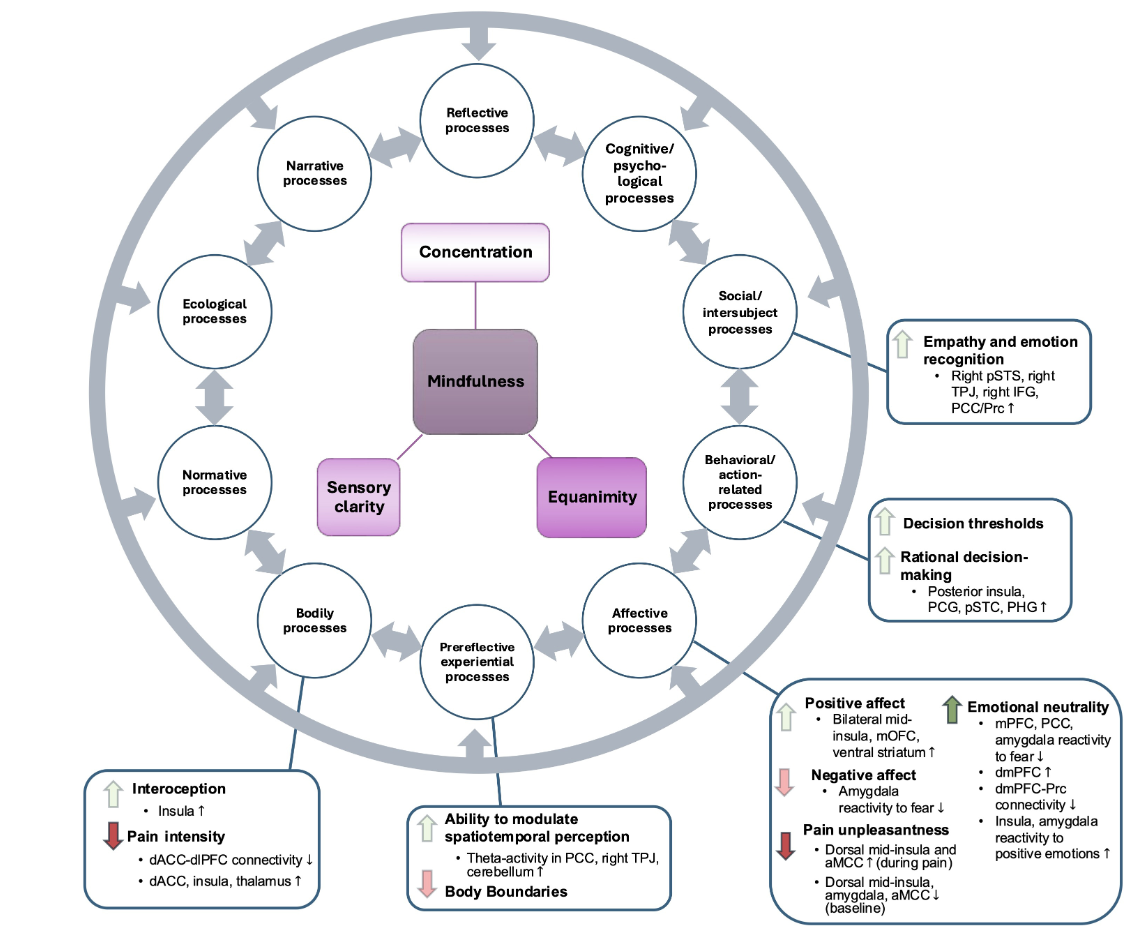
Perception and Interoception. LTMs show improved accuracy in perceiving bodily sensations during body-scan meditation, and this improvement correlates with practice hours. However, cardiac interoceptive awareness (detecting one’s own heartbeat) does not appear to differ from non-meditators, suggesting that meditation’s effects on body awareness may depend on the specific practice and sensory channel.
Pain Perception. This is among the most robust findings. LTMs consistently report reduced pain unpleasantness compared with non-meditators, and some studies also find reduced pain sensitivity. The mechanism involves sensory-affective decoupling: meditators still register the sensory aspects of pain but show diminished emotional reactivity to it. This is mediated by cognitive defusion, an experiential distancing from thoughts and sensations. Observe-and-release practices (characteristic of Vipassana) are more effective than focused-attention techniques. Neurally, LTMs show increased activation in salience network regions (anterior insula, dorsal anterior cingulate) alongside decreased activation in prefrontal appraisal regions and amygdala, supporting a shift from cognitive-evaluative to sensory-discriminative processing.
Emotional Processing. LTMs display greater emotional neutrality, reduced negative affect, and lower anxiety. Loving-kindness and compassion meditation additionally increase positive affect. Neuroimaging reveals a complex picture: beginners rely on top-down prefrontal regulation of limbic regions, but as expertise develops, this gives way to more automatic, bottom-up emotional processing involving altered default mode network dynamics. Changes in self-awareness, rather than enhanced cognitive control, appear to drive these improvements.
Decision-Making. In the Ultimatum Game, meditators accept unfair offers more often than controls, indicating more rational and less emotionally reactive decision-making. Neural activity suggests they rely on interoceptive and somatosensory processing rather than prefrontal cognitive control. A separate study using drift-diffusion modeling found that meditators set higher decision thresholds, meaning they accumulate more information before committing to a choice.
Non-Ordinary States of Consciousness. LTMs more readily enter states characterized by altered time perception, dissolution of bodily boundaries, and effortless awareness. These experiences correlate with reduced default mode network activity (especially posterior cingulate cortex) and changes in temporoparietal junction function. Observe-and-release practices are particularly effective at inducing these states, likely because they cultivate attentional disengagement and passive agency. These findings were largely state-dependent rather than trait-level.
Neural Synthesis
The authors contextualize their findings through the Pattern Theory of Self (Gallagher, 2013), which treats the self as a dynamic configuration of bodily, affective, behavioral, social, and narrative processes. LTMs show a reweighting of the self-pattern: enhanced bottom-up, embodied processing (sensory clarity) and reduced narrative self-referential activity (equanimity). This aligns with the “Topographical Reorganization of Meditation” model, which posits that meditation progressively shifts processing from higher-level mental self-processing to lower-level interoceptive and exteroceptive self-processing.
Key neural signatures include: increased salience network activation, reduced within-DMN connectivity, decoupling of prefrontal and pain/affective regions, and altered insula function (increased posterior, decreased anterior, with rightward lateralization). These patterns suggest a dispositional reconfiguration toward more distributed, embodied modes of cognition rather than enhanced cognitive control per se.
Limitations
The reviewed studies face several methodological challenges. Sample sizes are small. Meditation experience is reported inconsistently (some studies report only years, others total hours, others neither), and descriptions of specific meditation techniques vary widely, making cross-study comparison difficult. Almost no studies collected first-person phenomenological data that would distinguish LTMs from true AMs. Cultural and demographic context is largely ignored. The authors call for unified research frameworks, standardized measurement, preregistered longitudinal designs, and systematic collection of phenomenological data.
Conclusion
LTMs exhibit a distinct neurophenomenological profile characterized by enhanced equanimity and sensory clarity, supported by reorganization of large-scale brain networks. These changes likely reflect a shift toward more embodied, flexible self-processing rather than strengthened cognitive control. Future research should move beyond simple duration-based metrics and investigate meditative development through skill-based assessment, combining brain data with first-person reports. The field must develop integrated frameworks that capture the states, stages, and endpoints of advanced meditation to understand both its transformative potential and its associated risks.
 reply via email