Eichmann in Jerusalem: A Report on the Banality of Evil
February 3, 2026
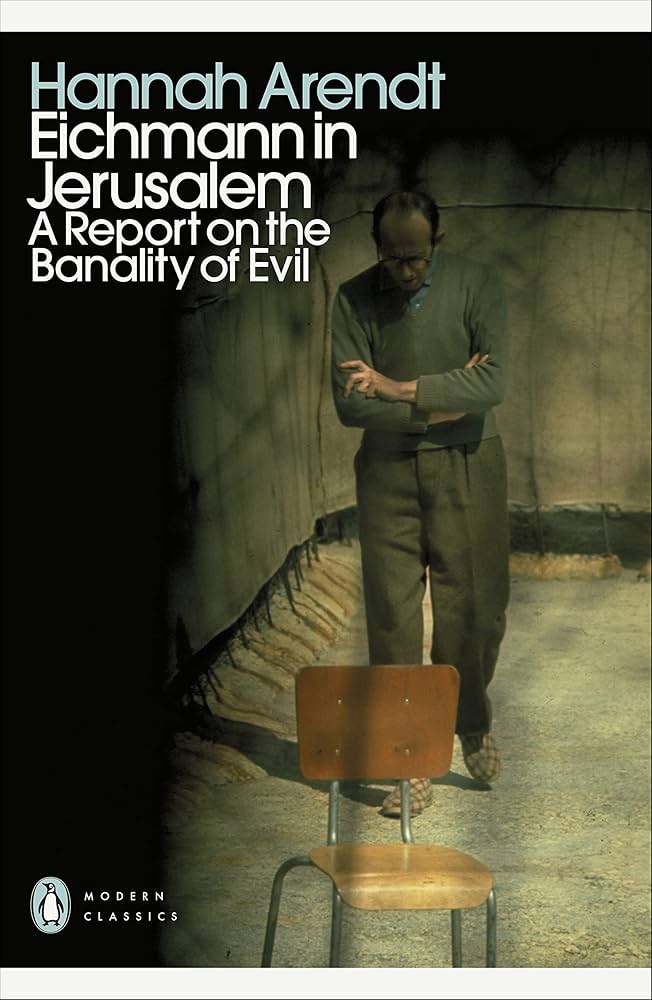
Never thought I would read the book of Martin Heidegger’s mistress before his. Anyway, the book is about the trial of the Nazi Adolf Eichmann, who played a major role during World War II in deporting Jews to extermination camps. He was arrested in Argentina by the Mossad and then tried in Jerusalem for crimes against humanity.
For the content of the book, I’ll quote Wikipedia, as it does a better job than me at summarizing it:
- Eichmann’s inability to think for himself was exemplified by his consistent use of “stock phrases and self-invented clichés”. He demonstrated his unrealistic worldview and crippling lack of communication skills through reliance on “officialese” (Amtssprache) and the euphemistic Sprachregelung (convention of speech) that made implementation of Hitler’s policies “somehow palatable”. While Eichmann might have had antisemitic leanings, Arendt argued that he showed “no case of insane hatred of Jews, of fanatical antisemitism or indoctrination of any kind. He personally never had anything whatever against Jews” according to his own testimony.
- Eichmann was a “joiner” his entire life, in that he constantly joined organizations in order to define himself, and had difficulties thinking for himself without doing so. As a youth, he belonged to the YMCA, the Wandervogel, and the Jungfrontkämpferverband. In 1933, he failed in his attempt to join the Schlaraffia (a men’s organization similar to Freemasonry), at which point a family friend (and future war criminal) Ernst Kaltenbrunner encouraged him to join the SS. At the end of World War II, Eichmann found himself depressed because “it then dawned on him that thenceforward he would have to live without being a member of something or other”. Arendt pointed out that his actions were not driven by malice, but rather blind dedication to the regime and his need to belong, to be a joiner. In his own words: “I sensed I would have to live a leaderless and difficult individual life, I would receive no directives from anybody, no orders and commands would any longer be issued to me, no pertinent ordinances would be there to consult—in brief, a life never known before lay ahead of me.”
- Despite his claims, Eichmann was not, in fact, very intelligent. As Arendt details in the book’s second chapter, he was unable to complete either high school or vocational training, and only found his first significant job, as a traveling salesman for the Vacuum Oil Company, through family connections. Arendt noted that, during both his SS career and Jerusalem trial, Eichmann tried to cover up his lack of skills and education, and even “blushed” when these facts came to light.
- Arendt confirms Eichmann and the heads of the Einsatzgruppen were part of an “intellectual elite.” Unlike the Einsatzgruppen leaders, however, Eichmann would suffer from a “lack of imagination” and an “inability to think."[7] Arendt confirms several points where Eichmann actually claimed he was responsible for certain atrocities, even though he lacked the power or expertise to take these actions. Moreover, Eichmann made these claims even though they hurt his defense, hence Arendt’s remark that “Bragging was the vice that was Eichmann’s undoing”. Arendt also suggests that Eichmann may have preferred to be executed as a war criminal than live as a nobody. This parallels his overestimation of his own intelligence and his past value in the organizations in which he had served, as stated above. Arendt argues that Eichmann, in his peripheral role at the Wannsee Conference, witnessed the rank-and-file of the German civil service heartily endorse Reinhard Heydrich’s program for the Final Solution of the Jewish question in Europe (German: die Endlösung der Judenfrage). Upon seeing members of “respectable society” endorsing mass murder, and enthusiastically participating in the planning of the solution, Eichmann felt that his moral responsibility was relaxed, as if he were “Pontius Pilate”.
- During his imprisonment before his trial, the Israeli government sent no fewer than six psychologists to examine Eichmann. These psychologists found no trace of mental illness, including personality disorder. One doctor remarked that his overall attitude towards other people, especially his family and friends, was “highly desirable”, while another remarked that the only unusual trait Eichmann displayed was being more “normal” in his habits and speech than the average person.
- She points out that Eichmann was kidnapped by Israeli agents in Argentina and transported to Israel, an illegal act, and that he was tried in Israel even though he was not accused of committing any crimes there. “If he had not been found guilty before he appeared in Jerusalem, guilty beyond any reasonable doubt, the Israelis would never have dared, or wanted, to kidnap him in formal violation of Argentine law.”
- She describes his trial as a show trial arranged and managed by Prime Minister Ben-Gurion, and says that Ben-Gurion wanted, for several political reasons, to emphasize not primarily what Eichmann had done, but what the Jews had suffered during the Holocaust. She points out that the war criminals tried at Nuremberg were “indicted for crimes against the members of various nations,” without special reference to the Nazi genocide against the Jews.
- She questions Israel’s right to try Eichmann. Israel was a signatory to the 1950 UN Genocide Convention, which rejected universal jurisdiction and required that defendants be tried “in the territory of which the act was committed” or by an international tribunal. The court in Jerusalem did not pursue either option.
- Eichmann’s deeds were not crimes under German law, as, at that time, in the eyes of the Third Reich, he was a law-abiding citizen. He was tried for ‘crimes in retrospect’.
- The prosecutor, Gideon Hausner, followed the tone set by Prime Minister Ben-Gurion, who stated, “It is not an individual nor the Nazi regime on trial, but antisemitism throughout history.” Hausner’s corresponding opening statements, which heavily referenced biblical passages, was “bad history and cheap rhetoric,” according to Arendt. Furthermore, it suggested that Eichmann was no criminal, but the “innocent executor of some foreordained destiny.
The most important message of this book is captured in its subtitle, “the banality of evil.” Adolf Eichmann was not a fanatic, not particularly intelligent, not a sociopath, and not driven by a strong ideology. He was an average, mundane person. In that sense, he was “banal.” His atrocious acts were motivated by banal reasons: wanting to be liked, wanting to do a good job, wanting to advance his career, nothing exceptional was needed.
I want to end with a quote from the book:
You admitted that the crime committed against the Jewish people during the war was the greatest crime in recorded history, and you admitted your role in it. But you said you had never acted from base motives, that you had never had any inclination to kill anybody, that you had never hated Jews, and still that you could not have acted otherwise and that you did not feel guilty. We find this difficult, though not altogether impossible, to believe; there is some, though not very much, evidence against you in this matter of motivation and conscience that could be proved beyond reasonable doubt. You also said that your role in the Final Solution was an accident and that almost anybody could have taken your place, so that potentially almost all Germans are equally guilty. What you meant to say was that where all, or most all, are guilty, nobody is. This is an indeed quite common conclusion, but one we are not willing to grant you. And if you don’t understand our objection, we would recommend to your attention the story of Sodom and Gomorrah, two neighboring cities in the Bible, which were destroyed by fire from Heaven because all the people in them had become equally guilty. This, incidentally, has nothing to do with the newfangled notion of collective guilt,’ according to which people supposedly are guilty of, or feel guilty about, things done in their name but not by them – things in which they did not participate and from which they did not profit. In other words, guilt and innocence before the law are of an objective nature, and even if eighty million Germans had done as you did, this would not have been an excuse for you. “Luckily, we don’t have to go that far. You yourself claimed not the actuality but only the potentiality of equal guilt on the part of all who lived in a state whose main political purpose had become the commission of unheard-of crimes. And no matter through what accidents of exterior or interior circumstances you were pushed onto the road of becoming a criminal, there is an abyss between the actuality of what you did and the potentiality of what others might have done. We are concerned here only with what you did, and not with the possible noncriminal nature of your inner life and of your motives or with the criminal potentialities of those around you. You told your story in terms of a hard-luck story, and, knowing the circumstances, we are, up to a point, willing to grant you that under more favorable circumstances it is highly unlikely that you would ever have come before us or before any other criminal court. Let us assume, for the sake of argument, that it was nothing more than misfortune that made you a willing instrument in the organization of mass murder; there still remains the fact that you have carried out, and therefore actively supported, a policy of mass murder. For politics is not like the nursery; in politics obedience and Support are the same. And just as you supported and carried out a policy of not wanting to share the earth with the Jewish people and the people of a number of other nations – as though you and your superiors had any right to determine who should and who should not inhabit the world – we find that no one, that is, no member of the human race, can be expected to want to share the earth with you. This is the reason, and the only reason, you must hang.