Gods Debris
December 10, 2025
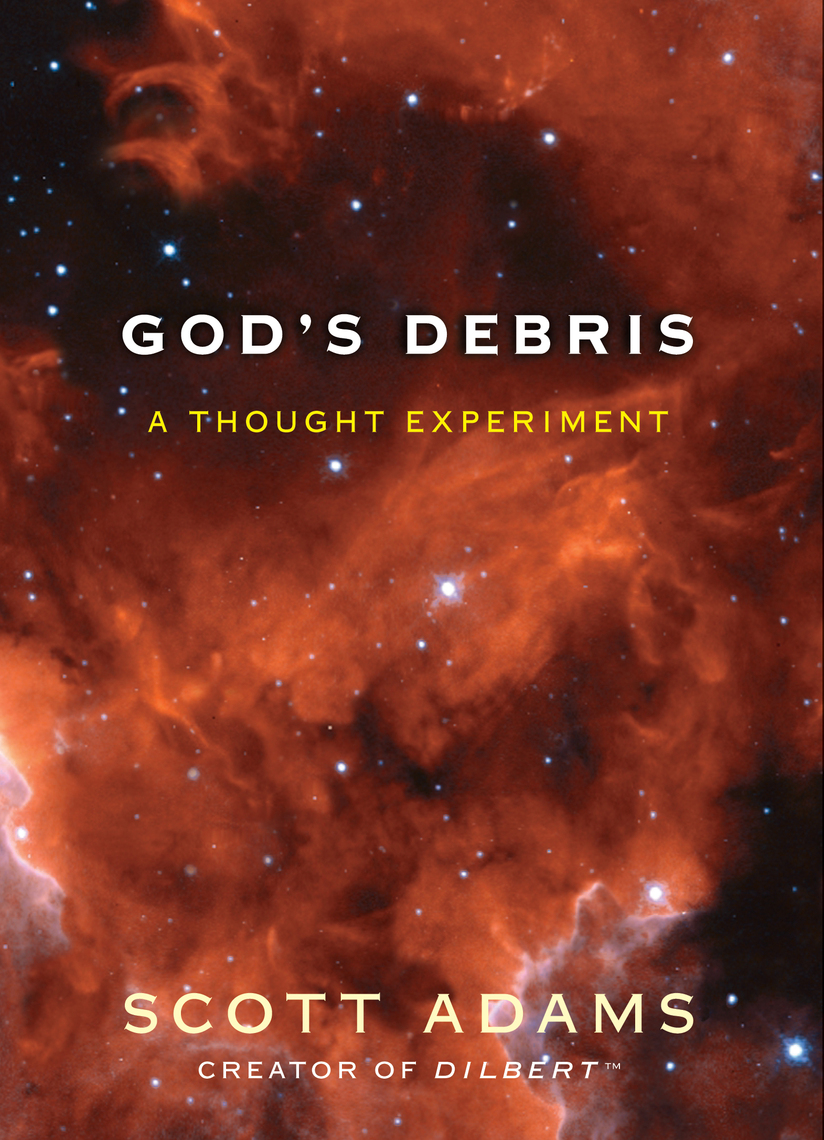
God’s Debris is a short novel by the author Scott Adams. It takes the form of a dialogue between two characters, a teacher-like figure and a student-like figure, in which the teacher attempts to give the student certain philosophical insights by questioning his beliefs. In this sense, it resembles the Platonic dialogues. Though I wouldn’t take the book too seriously, it contains some very interesting ideas that are worth pondering.
Below are some of my thoughts on the book and on certain passages in it. It isn’t yet very formalized, maybe I will do that later, or maybe not:
- Science can’t answer “why” questions, very similar to what Alex O’Connor talks about or what Bernardo Kastrup discusses in analytic idealism.
- Science can only tell us how things behave, because of how our experiments are structured: we do something and then observe what happens.
- Science can never tell us what is in an ultimate sense; science is a predictive model. It tells us: if one thing happens, what will then happen?
- The thought about free will, especially regarding dualism — the idea that we have physical things and non-physical things (souls). Problems:
- How do the physical and non-physical interact?
- How does a soul know to influence only your body and never someone else’s? How does it avoid ever making a mistake?
- He talks about how there are 4 billion people worldwide who claim to believe in God, but that they only claim to. If they truly believed, every waking moment would be influenced by this.
- One would give all their wealth away.
- One would be in a state of genuine, frantic searching.
- If we instead assume people do not really believe in God, but say they do because of social credit, this would explain why we do not see that radical devotion in practice.
- See: Jordan Peterson, Kierkegaard, Nietzsche: “there is only one true Christian, and that is Jesus.”
- Religions are like roadmaps.
- I like to call them interpretative frameworks. Interpretative of what? Of the Abgrund of Being, ecstasy, the sublime: the things people who have glimpsed “something beyond” try to make sense of.
- What is this “beyond”? That is what the interpretative frameworks are for.
- What does authenticity mean?
- If we say it means “being yourself,” this is a truism: we are always ourselves.
- Heidegger talks about something similar: even if one chooses to be ignorant about Dasein and live inauthentically, this choice is still part of Dasein.
- Maybe another definition: not cowering to social pressures, i.e., not compromising internal belief-states because of external factors. But even those internal states come from the external world.
- Humans are delusion generators.
- The brain is a filter. It filters out non-relevant information because evolutionarily it is advantageous to see only what is strictly necessary for survival.
- Psychedelics show that there is more information out there; under psychedelics the filtering function is, to some extent, disabled.
- Why do we place higher value on humans than on other things?
- Is it because they are more interesting?
- The fact that some things matter more than others likely comes from evolutionary pressures and from the limitations of time, a god wouldn’t have that, for him a stone would be as interesting as a human.
- Heidegger: Being as confrontation with finitude.
- The book Heaven and Hell (or similar ideas): it doesn’t need to value things differently; it just is. Neutral. Buddhism. Echkahrt: issigkeit.
- Things like UFOs, reincarnation, and God. What are they about?
- They tell us more about human nature than about the things-in-themselves.
- Heidegger: ontics vs. phenomenology.
- “The only challenge for God would be to kill Himself.”
- Interesting thought, but again too human. It imagines God as a subject who has challenges. A stone has no “challenges.” why should god be more similar to use humans than to a stone?
- Plotinus: God is beyond Being; Being comes from Him.
- Experiencing “not-being” makes no sense for such a principle.
- “Killing itself” Interpreted differently, this resembles analytic idealism: the universe “wants to kill itself” = the universe wants to observe itself. How can it do that? Through us. When we die, we return that information to the universe.
- A God who has one nagging question: “what is it like not to exist?” would be motivated to act.
- But why assume God cannot transcend Being? Paul Tillich: God is beyond Being or the Ground of Being.
- Does a number experience time? The question itself is nonsensical.
- Our world and language are too limited to deal with anything except a fixed reality.
- Wittgenstein would agree.
- See: On Mysticism: The Experience of Ecstasy and Heidegger — where language breaks down, it points to something beyond.
- I also really like the idea of becoming God — that was my first delusion (AI), and I’m still fond of it today.
- Science relies on assumptions: cause and effect.
- David Hume’s paper on causation.
- Zeno’s paradox, infinity, and the universe.
- Different theories say the universe is infinite or not.
- Different theories of time: A-theory, B-theory, presentism, eternalism.
- Quantum theory: only finitely many discrete states.
- Presentism doesn’t solve the issue.
- Heidegger on the nature of time.
- Plotinus VI.7: time.
- Problem with God being beyond time: how does He interact with time?
- Plotinus would say the question presupposes a mechanism inside the realm of beings, but the One’s relation is not a relation — it is the condition for relations.
- Tillich: Applying finite categories like “liftable” or “rock” to the Ground of Being is a category error.
- Example: “The number 5 is hungry.” Nonsense.
- Likewise: “Can God create a rock He cannot lift?”
- The paradox is a problem with the question, not with God.
- If two models explain the same thing, pick the simpler one — Ockham’s Razor.
- ESP → David Hume on what it takes to believe in wonders.
- Humanity as slightly psychotic collectively.
- People differ mainly in morality or willpower.
- C. S. Lewis: it is more impressive to go from low to middle than from middle to high.
- Without the fiction of will, there can be no responsibility.
- Some philosophy papers argue responsibility still can exist (Frankfurt, etc.).
- Holy lands — what does it mean to say a place is holy?
- There are no absolute coordinates, only relations between things (Dasein).
- If we take the whole of the holy land — what is “the” holy place?
- Ship of Theseus, teleportation papers, Sam Harris — identity is not binary but continuous.
- Something is only more or less the same.
- Same with a holy place: no constant essence.
- Heraclitus: everything flows.
- Why does this matter? Should one pray to God?
- Everyone contributes to society/economy and thereby to the realization of God.
- Same idea in AGI, everyone contributes to ralize AGI, which then will usher in utopia.
- The problem is finding meaning in something greater doesn’t work. See Ayers paper: Claims of Philosophy
- Why care about a replica? Why not care only about myself?
- Because identity is an illusion.
- Idea-guy vs. people-guy.
- You can only change what people know or what they do.
- People like to talk about themselves.
- Even if the question isn’t genuine, people like it.
- I disagree: I wouldn’t like someone pretending to listen or pretending to care. That’s not authentic.
- Women like sacrifices (symbolic ones). Men value accomplishment.
- When you hear a word for the first time and then suddenly hear it everywhere:
- Your brain can only process a tiny part of your environment; it risks being overwhelmed.
- So it filters out information until you “notice” it.
- Related to analytic idealism and psychedelics — selective attention.