- What faith is not
The most ordinary misinterpretation of faith is to consider it an act of knowledge that has a low degree of evidence. […]
One believes one piece of information is correct. One believes that a scientific theory is adequate for the understanding of a series of facts. One believes that a person will act in a specific way.
The Christian may believe in the Bible writers, but not unconditionally. He does not have faith in them. He should not even have faith in the Bible. For faith is more than trust in an authority [or knowledge with a low degree of evidence]. It is participation in the subject of one’s ultimate concern with one’s whole being. […]
Faith does not affirm or deny what belongs to pre-scientific or scientific knowledge of our world, whether we know it through direct knowledge [sense perception] or through the experiences of others. […]
Almost all the struggles between faith and knowledge are rooted in the wrong understanding of faith as a type of knowledge which has a low degree of evidence. […]
The certitude of faith is “existential”, meaning that the whole existence of man is involved. It has two elements: a certainty about one’s own being, namely one’s being related to something ultimate or unconditional; the other, namely the surrender to a concern which is not really ultimate and may be destructive if taken as ultimate. […]
The difficulty of understanding faith as a matter of intellect has led to the interpretation of faith as emotion. This solution was supported by both the religious and the secular side. For religion it was a retreat to a seemingly safe position after the battle of faith as knowledge. For the other side, it was readily accepted because they took it as the best way to get rid of interference from religion in the process of scientific research. […]
Neither of the two sides, the religious and the cultural [secular], could keep this well-defined covenant of peace. […]
It [faith] does not accept the situation “in the corner” of mere feeling. If the whole person is grasped, all his functions are grasped. […] It was not only religion which could not accept the restriction of faith to feeling. It was also not accepted by those who wanted to push religion into the emotional corner. Scientists, artists, moralists show clearly that they also were ultimately concerned. […]
Certainly faith, as an act of the whole personality, has strong emotional elements within it. […] But emotion is not the source of faith. Faith is definite in its direction and concrete in its content. […] It is directed towards the unconditional and appears in a concrete reality that demands and justifies such commitments.
~ Paul Tillich, Dynamics of Faith, Chapter2
- City the Animation
- Credence and Doubt
Faith is certain in so far as it is an experience of the holy. But faith is uncertain in so far as the infinite to which it is related is received by a finite being. This element of uncertainty [doubt] cannot be removed; it must be accepted. […]
[…] We must remember that faith as the state of ultimate concern includes total surrender to the content of this concern […]. This means that the existence of the personality in the ultimate sense is at stake. Idolatrous concern and devotion may destroy the center of personality. If, as in the Christian Church […], it is understandable that every deviation from the credence is considered destructive for the “soul” of the Christian. […]
All this drives to the question: How is a community of faith possible without suppression of man’s spiritual life?
No answer is possible if the character of the creed excludes the presence of doubt. [Without doubt] this faith has become static. […]
The fight against the idolatrous implication was waged first by Protestantism and then, when Protestantism itself became static, by Enlightenment. This protest, however insufficient its expression, aimed originally at dynamic faith and not at negation of faith, not even negation of creedal formulation. […]
So we stand again before the question: How can faith which has doubt as an element within itself be united with creedal statements of a community of faith?
The answer can only be that creedal expressions of the ultimate concern of the community must include their own criticism. It must become obvious in all of them—be they liturgical, doctrinal, or ethical expressions of faith—that they are not ultimate. Rather, their function is to point to the ultimate which is beyond all of them. This is what I call the “Protestant principle,” the critical element […] and consequently the element of doubt in the act of faith. […]
Certainly, the life of a community of faith is a continuous risk, if faith itself is understood as a risk. But this is the character of the dynamic of faith.
~ Paul Tillich, Dynamics of Faith, Chapter 1 §5-6
- The Holy
The human heart seeks the infinite because that is where the finite wants to rest. In the infinite it sees its own fulfillment. This is the reason for the ecstatic attraction and fascination of everything in which ultimacy is manifest. On the other hand, if ultimacy is manifest and excersises its fascinating attraction, one realizes at the same time the infinite distance of the finite from the infinite and, consequently, the negative judgment over any finite attempts to reach the infinite. The feeling of being consumed in the presence of the divine is a profound expression of man’s relation to the holy. It is implied in every genuine act of faith, in every state of ultimate concern.
~ Paul Tillich, Dynamics of Faith, Chapter 2 §4
- The Holy Mountain (1973)
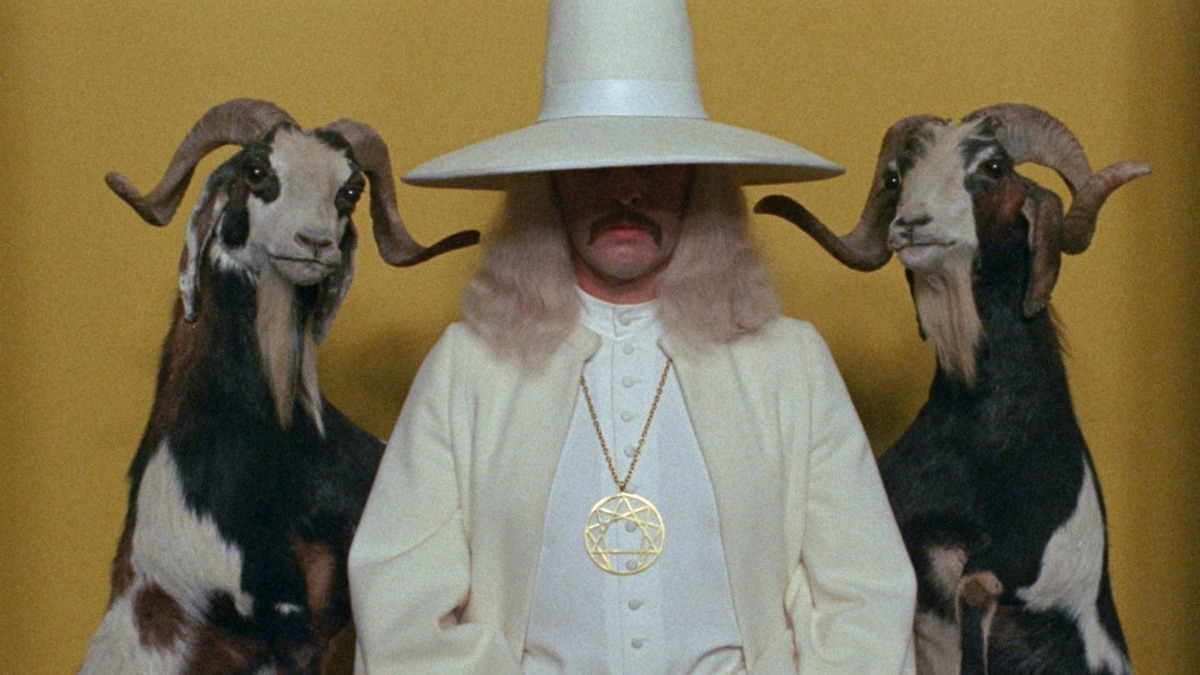
My immediate impression was, every scene was visually stunning, seemingly embedded with lots of meaning, but trying to find the meaning behind the scenes and put it together is hard. 7/10.
The movie is about a Christ-like figure and an Alchemist that leads eight people on a quest to find immortality.
The film, as described by the director Jodorowsky himself, is meant to do:
“what most North Americans ask of psychedelic drugs. The difference being that when one creates a psychedelic film, he need not create a film that shows the visions of a person who has taken a pill; rather, he needs to manufacture the pill.”
It is less meant to make conceptual sense, but more like to get the kind of self-insight one gets on a psychedelic trip, hard to put in words, a kind of transcendental experience.
If I had to put the big themes into words, it would probably be enlightenment. All of them are on a quest to reach immortality, which is nothing more than enlightenment. Throughout the movie, you see scene over scene of how corrupted humanity is: commodification, cruelty, and much more. Yet through all of this, people still yearn for something that transcends all this. All these material conditions serve as a distraction for enlightenment. Thus, we first see what prevents enlightenment, and then we get rid of it.
When they finally reach the promised mountain that is supposed to give immortality, only the Christ-like figure stays behind; the others go up the mountain. Here, the great twist happens:
“I promised you the great secret and I will not disappoint you. Is this the end of our adventure? Nothing has an end. We came in search of the secret of immortality. To be like gods. And here we are… mortals. More human than ever. If we have not obtained immortality, at least we have obtained reality. We began in a fairytale and we came to life! But is this life reality? No. It is a film. Zoom back camera. We are images, dreams, photographs. We must not stay here! Prisoners! We shall break the illusion. This is Maya (illusion). Goodbye to the holy mountain. Real life awaits us.”
There was no enlightenment; there is no immortality; there are no gods; there is no secret path or recipe for happiness or enlightenment. All that there is is reality.
And that is not only true for the characters of the movie but also for us, the audience. When the Alchemist breaks the fourth wall and seems to address us, the audience, directly with “Real life awaits us,” we have two meanings. The first for the eight people in the movie that followed the Alchemist to the mountain: There was no enlightenment, there is no immortality, there are no gods, there is no secret path or recipe for happiness or enlightenment, all that there is is reality. But this is not only true for the characters in the movie but also for us. While watching the movie, we were looking to get some insight on what the movie means, how to get enlightenment, and so on, but there is none of that, and like the eight, we the audience need to return to our lives no wiser than before. This is the second meaning.
But Jodorowsky offers a bit more, because what happened to the Christ-like figure that was left behind? He was left behind because there was never anything on the mountain for him in the first place. Instead, he united with the woman he loves:
“Unite yourself with this good woman, who came here only because she loves you. Forget the summits, reach eternity through love. Return to your country. I leave you my tower and my alchemical rooms. This is your family and your people.”
Thus, in fact, he is the only one reaching happiness through the teachings of the Alchemist. He transcended the corrupt society and achieved enlightenment on his own through love. Hence, the movie offers the message: those who seek enlightenment through power and corruption will never find it; only through love, self-discovery, and life itself can enlightenment be reached.
 I2P
I2P